AI Will Not Create a Civilization of Passive Consumers
Civilization does not drift toward passivity when technology amplifies the returns to human agency. The incentives are towards greater innovation, and most people respond to incentives.

Many discussions about AI assume a trajectory where automation removes the need for human effort, causing people to drift into passivity, dependency, and cognitive atrophy.
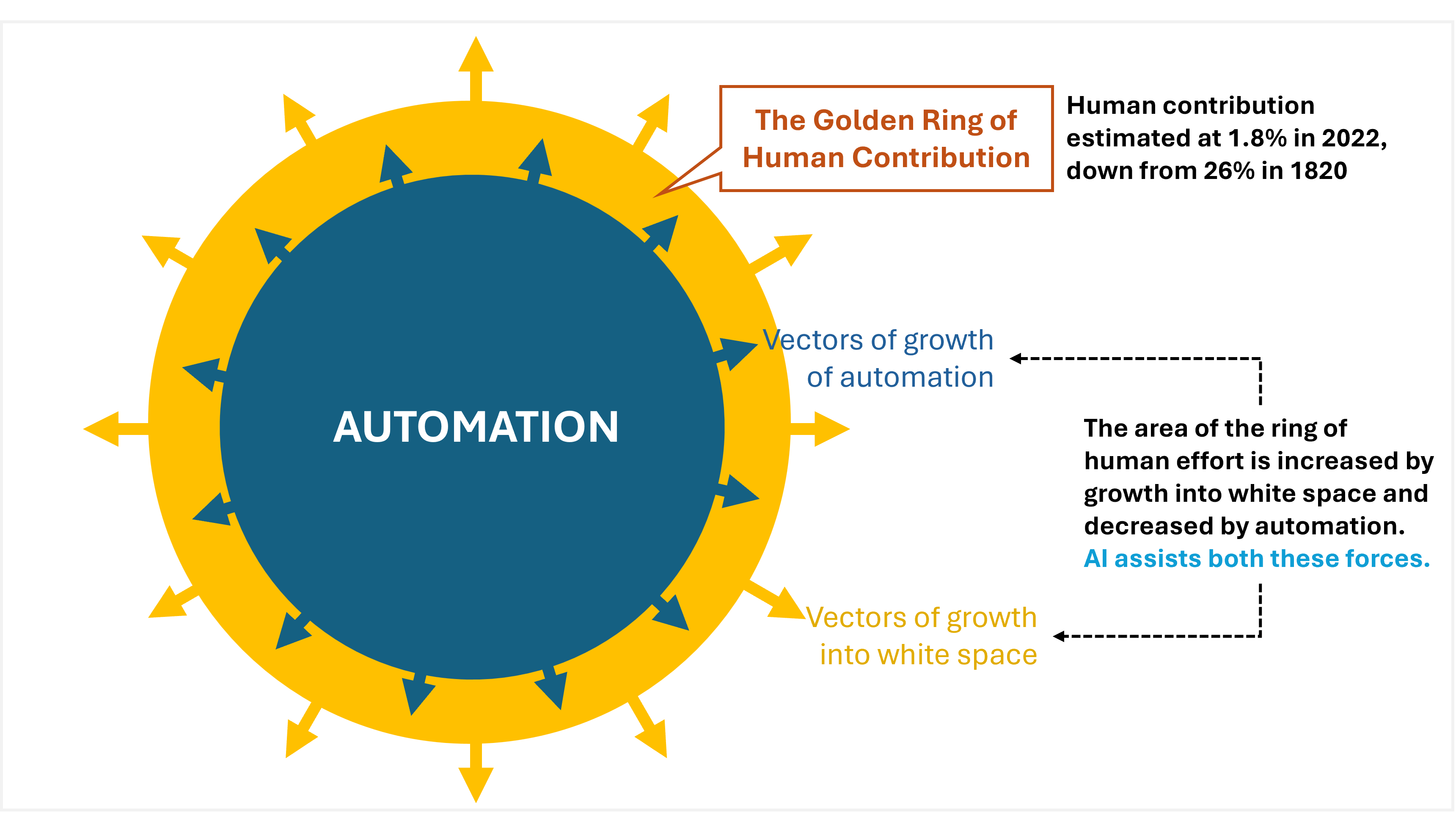
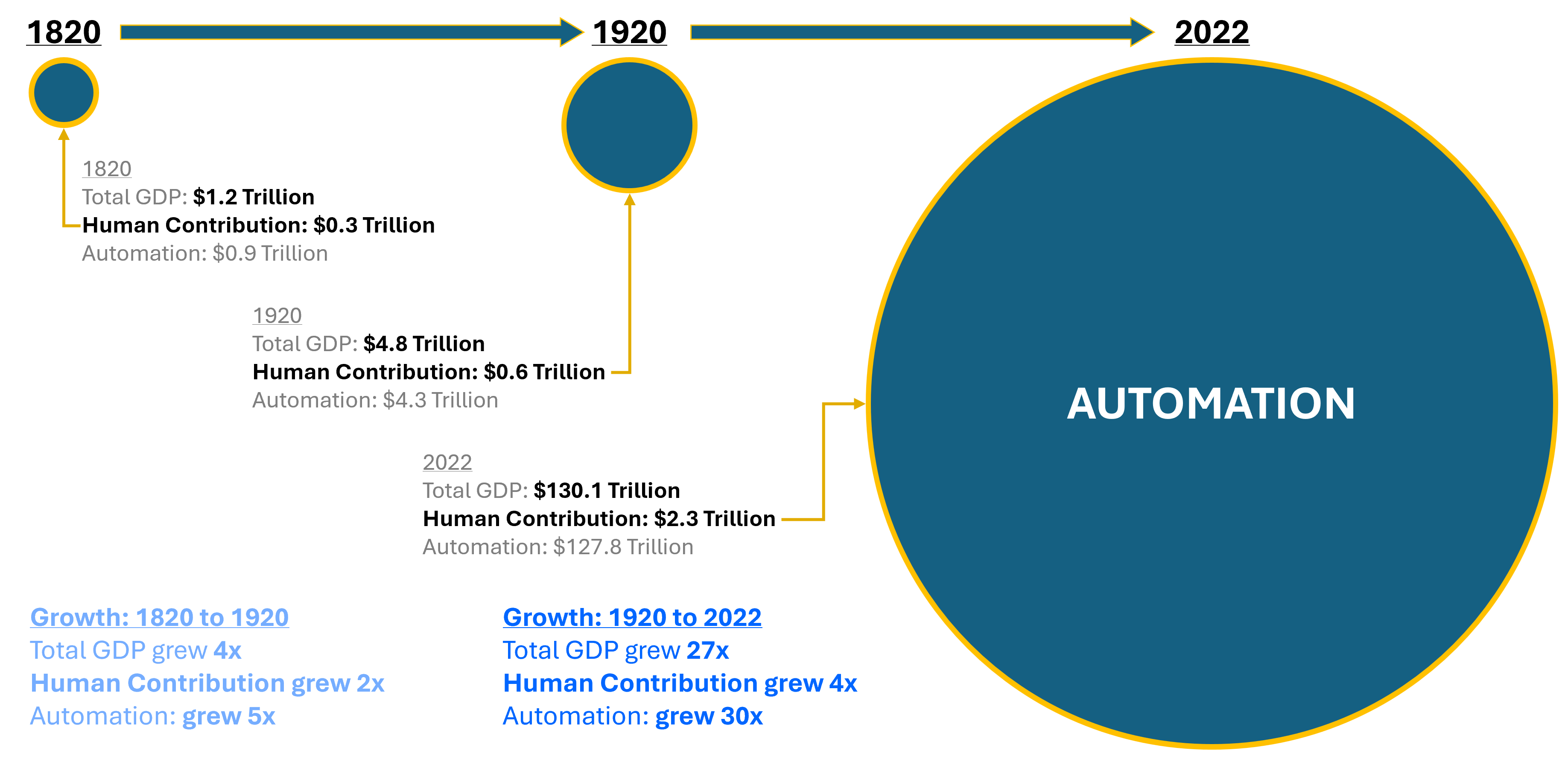
This misunderstands both civilization and human incentives. I wrote a paper that deals with the foundations of this issue: AI as an Acceleration of Human Civilization that posits the frame of a Golden Ring of Human Contribution. In it I argue that most civilization output is already mediated through accumulated automation and infrastructure rather than direct human effort. So humans remain causally important at the frontiers (the edges of the Golden Ring) while becoming economically smaller in relative share even as civilization becomes vastly richer overall.
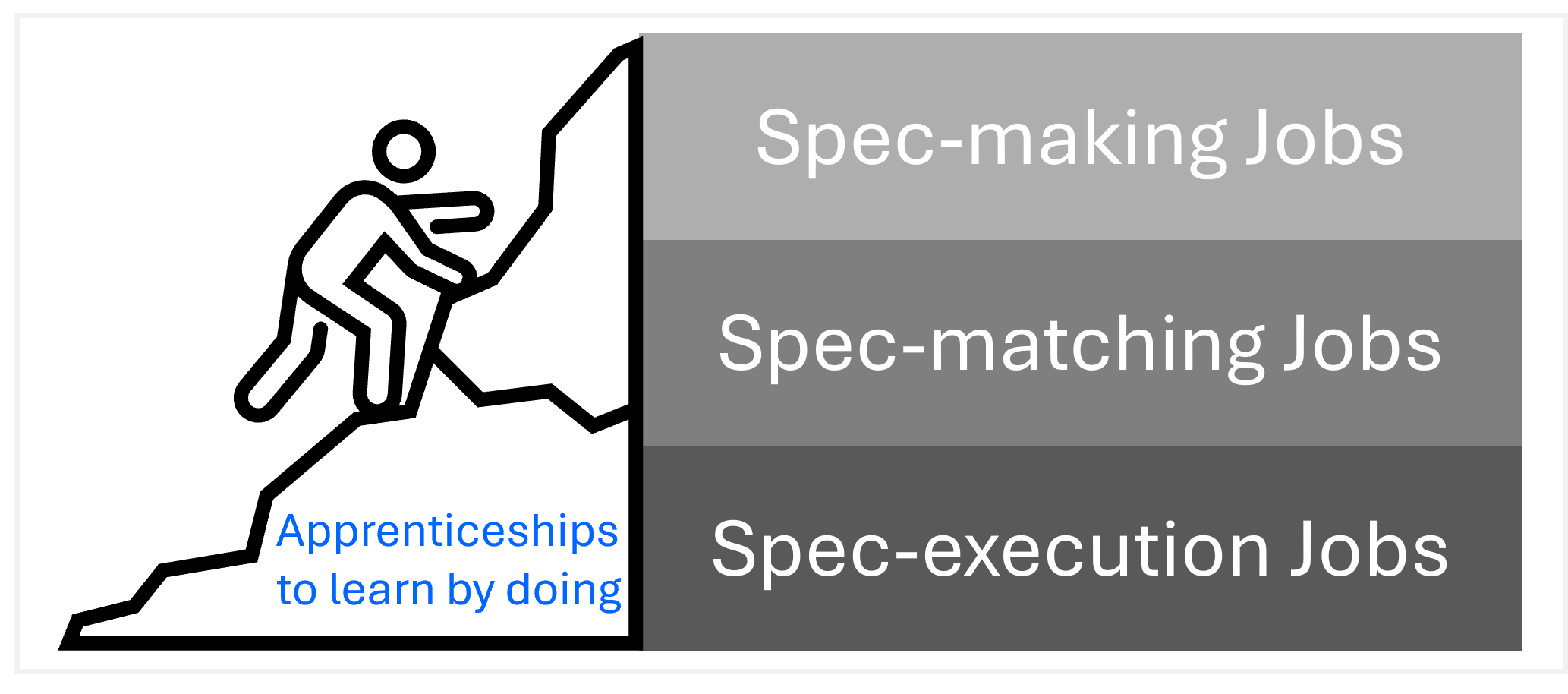
In the AI era, as stable spec-execution work becomes increasingly automated, the economic premium shifts toward spec-matching and spec-making: ambiguity handling, problem-solving, innovation, systems thinking, judgment, coordination, and exploration. Contrast this to the industrial era that required people to do large amounts of stable spec-execution work: repetitive, standardized, process-following labor. Education systems, corporate structures, and managerial hierarchies evolved to produce humans capable of reliably performing such work at scale.
The result is not the elimination of human contribution. It is the migration of human contribution outward into higher-order cognitive work.
More fundamentally, AI changes the selection pressures acting on human cognition. The industrial era selected for compliant, process-following cognition because civilization needed humans capable of reliably performing repetitive work at scale. The AI era increasingly rewards adaptive reasoning, problem-solving, systems thinking, judgment, creativity, and exploratory cognition because these become the scarce bottlenecks in an increasingly automated civilization.
The fear that the wealth generated by AI will be used to sedate civilization resembles long-standing fears around drugs, entertainment, and other forms of passive consumption. Such narcotics have been with us forever. Yet civilization did not collapse into universal narcotization despite millennia of access to intoxicants and escapist behavior.
Why? Because civilizations contain powerful competitive selection pressures rooted in status, survival, wealth accumulation, reproductive success, and institutional competition. Individuals, firms, institutions, and nations that innovate, adapt, organize, and learn faster compound capability over time and outperform those that drift into passivity or optimize primarily for comfort. The transition from agrarian to industrial civilization was itself driven by populations intensely focused on acquiring the skills required to “get ahead” in the new economy. Even those who settled into stable industrial-era roles typically sought upward mobility for their children. AI strengthens these competitive pressures rather than weakening them because it increases the leverage of adaptive cognition relative to routine execution.
Civilization resists sedation. AI strengthens the competitive pressures that drive humans toward higher-order cognition.
The more capable AI becomes, the greater the leverage of high-agency humans becomes. One AI-amplified innovator can now orchestrate systems, automate workflows, conduct research, design products, build organizations, and influence millions of people at global scale.
As execution becomes cheaper, deciding what should be executed becomes more valuable. This increases the premium on spec-making capabilities: systems design, strategic judgment, entrepreneurship, and exploration.
The challenge is not that humans become obsolete. The challenge is that the developmental ladder changes. Historically, people learned higher-order judgment by first doing lower-order execution work. Apprentices became masters through exposure to constrained execution environments. If AI compresses entry-level execution work, societies must redesign education and apprenticeship around problem-solving, experimentation, and adaptive reasoning rather than procedural repetition. AI itself becomes part of the scaffolding system for this transition, alongside redesigned apprenticeships, experimentation environments, and tool-mediated learning.
There will absolutely be cohorts that optimize for passive consumption. But they are unlikely to become dominant because status competition, economic competition, and geopolitical competition continuously regenerate demand for elevated cognition.
The likely outcome is bifurcation: increasingly AI-amplified spec-makers at the frontier, alongside populations that allocate more of their lives toward passive consumption and low-agency equilibria. The true risk of this bifurcation is the creation of a cognitive barrier. Above this threshold, high-agency individuals leverage AI to explore and innovate, with the technology dramatically scaling their capabilities. Below it, a psychological trap takes hold: when individuals see that the machine consistently outperforms them, they begin blindly deferring to its outputs. This passivity triggers cognitive atrophy, cementing a self-reinforcing slide into technological dependency. Crossing this barrier requires an immense expenditure of agency and effort, a leap that may not be feasible for many.
Yet, this barrier is not a rigid demographic divide; rather, it represents two modes of operating that individuals navigate dynamically. Even highly capable innovators periodically disengage into passive entertainment and recovery, while many otherwise passive individuals intermittently pursue learning, entrepreneurship, creativity, and real-world challenge. The distinction is therefore civilizational and statistical rather than absolute: AI increases the leverage and influence of active cognition even while passive consumption remains widespread.
The best innovators will continue to have a spread of outcomes, wins and losses. Civilization has always been disproportionately shaped by the minorities who succeed in innovation. AI increases the leverage of those minorities.
This makes the old calculation of “Labor Share of Income” suspect as a tracker. It reflected the bargaining power of labor to capture a part of the income. As labor shifts to spec-making innovation, and AI amplifies the gains from it, the income flowing into the innovators’ hands creates a new category of Innovators’ Share of Income that used to be irrelevant earlier as it lived on the edges of Labor Share & Capital Share.
AI therefore does not merely automate tasks. It reorganizes the cognitive selection pressures acting on civilization itself. The Golden Ring of human contribution continues its historical migration: routine work moves inward into the automation core, while human contribution moves outward into the white space of imagination, innovation, and frontier-making.
AI is not the end of human relevance. It is the acceleration of civilization toward higher-order cognition.
References
Saxena, Rahul. AI as an Acceleration of Human Civilization: AI Disruption is a facet of Civilizational Acceleration. SSRN, 27 Mar. 2026, SSRN-6482860.